
Happy Memorial Day!
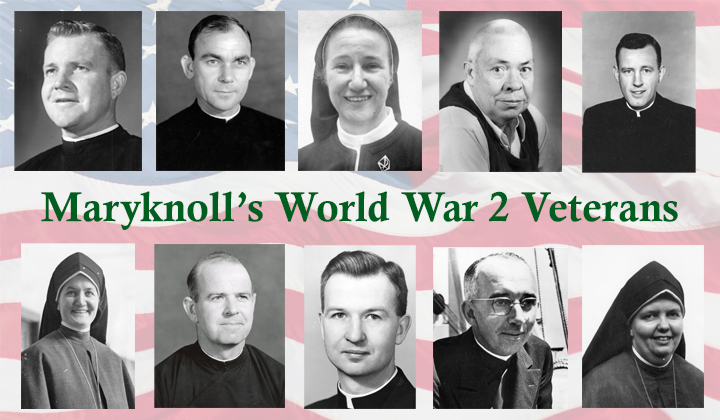
Another year has passed and it is time again to celebrate all those who have served in The United States Armed Forces. For this year, I will focus on the veterans of World War 2. There are a total of 86 Maryknollers who served in a wide variety of military roles during the war. Of these 86, 8 Maryknoll Fathers acted as Chaplains for the Army, Marines, and Navy. The other 78 consists of 38 future Fathers, 31 future Brothers, and 9 future Sisters whom served in the Army, Navy, Marines, Army and Navy Air Corps, Merchant Marine, and Coast Guard.
If I featured everyone like with the World War 1 Veterans, this post would be pages long. Instead, I am going to take the time to highlight 10 individuals from the Fathers, Brothers, and Sisters covering each military branch. Each person served in an unique role and we will explore how their service fit into the larger war effort. Let’s learns something new while we celebrate some of Maryknoll’s World War 2 veterans!
You Will Be Asking…
At the bursting of bombs in Pearl Harbor, it was as if a curtain flew up before our eyes and left us gazing out a window at a new and different world. We in America had been reading about war. Now we were in the midst of war. The nation must participate in a hideous armed conflict.
What a pity that, before earthly empires sought to execute their plans in terms of world dominion, the spiritual dominion of Christ could not become more completely world-wide. If all men were possessed of Christ, our efforts could be fixed open persuading men to act by Christ. But we must not be dismayed. The task lies before us, and Maryknoll appreciates the portion of responsibility which it bears.
– The Field Afar, February 1942, Page 2.
Fathers
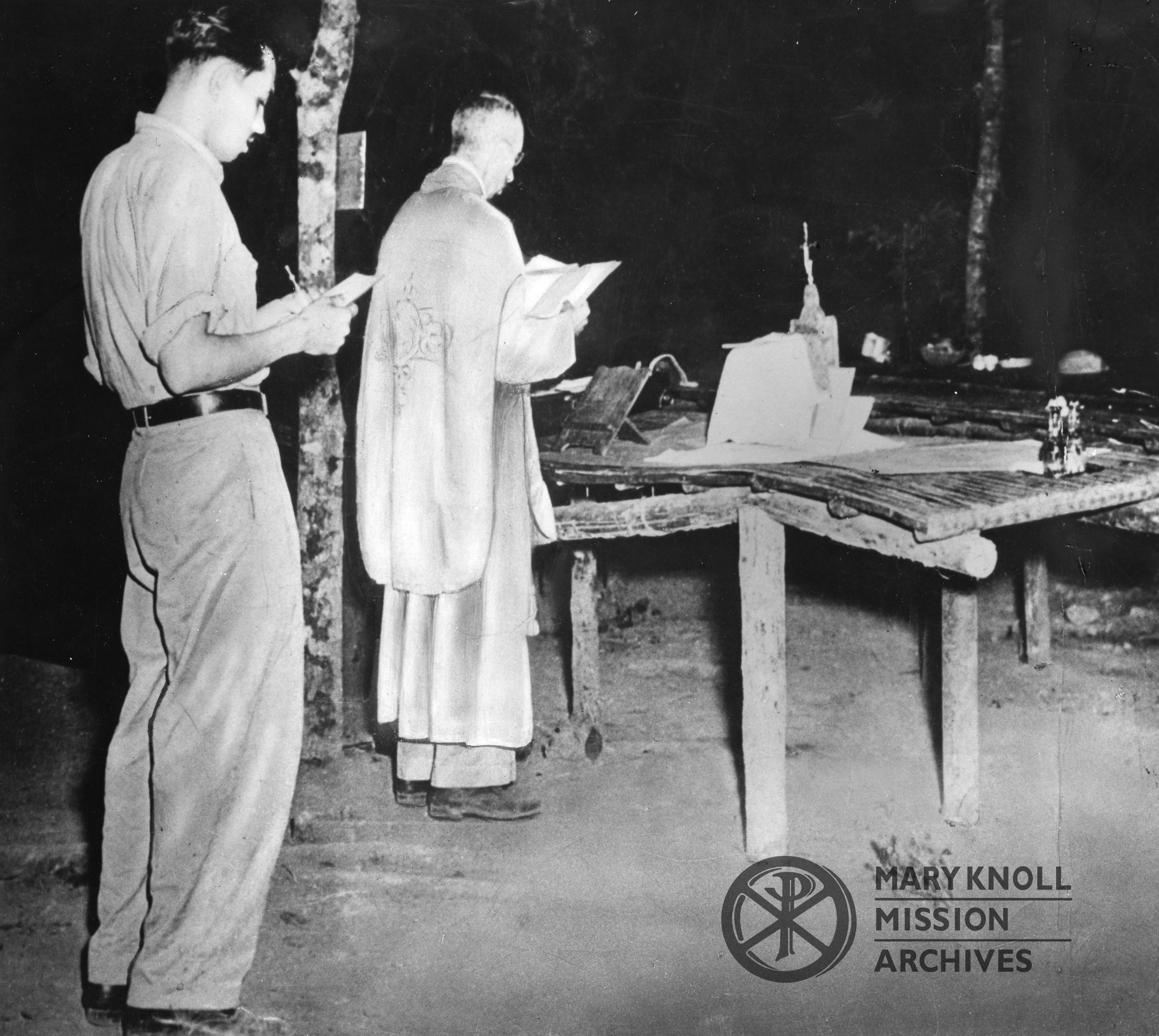
The first of the Fathers I will feature is Father William T. Cummings, a Maryknoller in the Philippines during the Japanese attack on the islands. He joined the Army’s garrison as a chaplain and served through the Fall of Bataan. Fr. Cummings became a Prisoner of War, where he continued to serve as the chaplain and spiritual advisor for most of the war. He survived harsh conditions in POW camps and the sinking of his prison ship, the Ōryoku Maru. Fr. Cummings was a shining beacon of hope for all who came into contact with him until he succumbed to the poor conditions on January 18th, 1945.
Next, let’s shine the spotlight on Fr. James L. Lenihan, one of the United States’ Merchant Marine. When the war started James Lenihan was in High School. He applied and was accepted to the United States Merchant Marine Academy, where he learned to be a sailor. James would crew one of the thousands of cargo ships vital in transporting supplies and troops across vast oceans to support the Allied war effort. Among the many ports James visited was Dar Es Salaam, where he would return years later as a Maryknoll Missioner.
The last Father to highlight is Father Daniel D. Dolan, a member of the Navy’s air corps. Daniel Dolan spent most of the war aboard Carriers in the Pacific, starting out as a navigator and bombardier. After 9 months, Daniel went to Flight training, earned his pilot’s wings, and joined a Corsair Fighter Squadron aboard the USS Randolph. His passion for flying continued into civilian life, only halting when he applied to join Maryknoll.
Brothers
For the Brothers, I want to start with Br. John J. Wohead, who served in Europe with the Army Air Corps. John was an enlisted man part of the 306th Bomber Group, 432nd Bombardment Squadron, serving as a corporal. Based on his rank and skills as a welder, John most likely served as a ground crewman or mechanic. While ground crew did not see combat, they were vital for keeping planes operational and the war effort going.
Sticking with the Army, let’s shift our focus to Br. Alphonse Gross. He enlisted as in the Army Corp of Engineers before the war started, serving with 10th Engineer Battalion besides the 3rd Infantry Division. His service took him from North Africa to Sicily and Italy, then Southern France, the Rhineland, and across Central Europe. As an engineer, he supported the front line troops and helped ensure the Infantry could overcome any physical obstacle.
Moving to the Pacific, the spotlight shifts to Br. Owen Walsh, whom joined the Navy in 1943. His services was with an incredibly underrated group, the Seabees (slang for the Navy designation: CB or Construction Battalion). These Navy engineers worked alongside the Marines throughout Guadalcanal and the Island Hopping Campaigns. Their efforts kept vital infrastructure running as American forces fought ferociously for each island. Without their work, the Battle of Guadalcanal may have been lost without their repairs of Henderson Airfield. The same goes for the subsequent island battles, which Br. Walsh was a part of.
Our last Brother to feature is a former Marine, Br. Venard Ruane. During the war, he served in Guam and Tientsin, China as a Chaplain’s aide. In his spare time, Br. Venard began reading The Field Afar, Maryknoll’s premier magazine. This, combined with several experiences with missioners, lead him down the road of religious life. Even in war, one can find the light of the path and be called to a greater purpose.
Autobiography
… Then Dec. 7, 1941 came and on that day a group of us were at an afternoon dance in Floral Park on that Sunday Afternoon. It was only some time later we began to realize that when we finished High School in January 1943, we would be going into the War.
In October of 1942 I took the academic and physical exam… to enter the United States Merchant Marine Academy located at King’s Point, on Long Island. I was accepted and entered the Academy in March 1943.
– Fr. James L. Lenihan, MM
Sisters
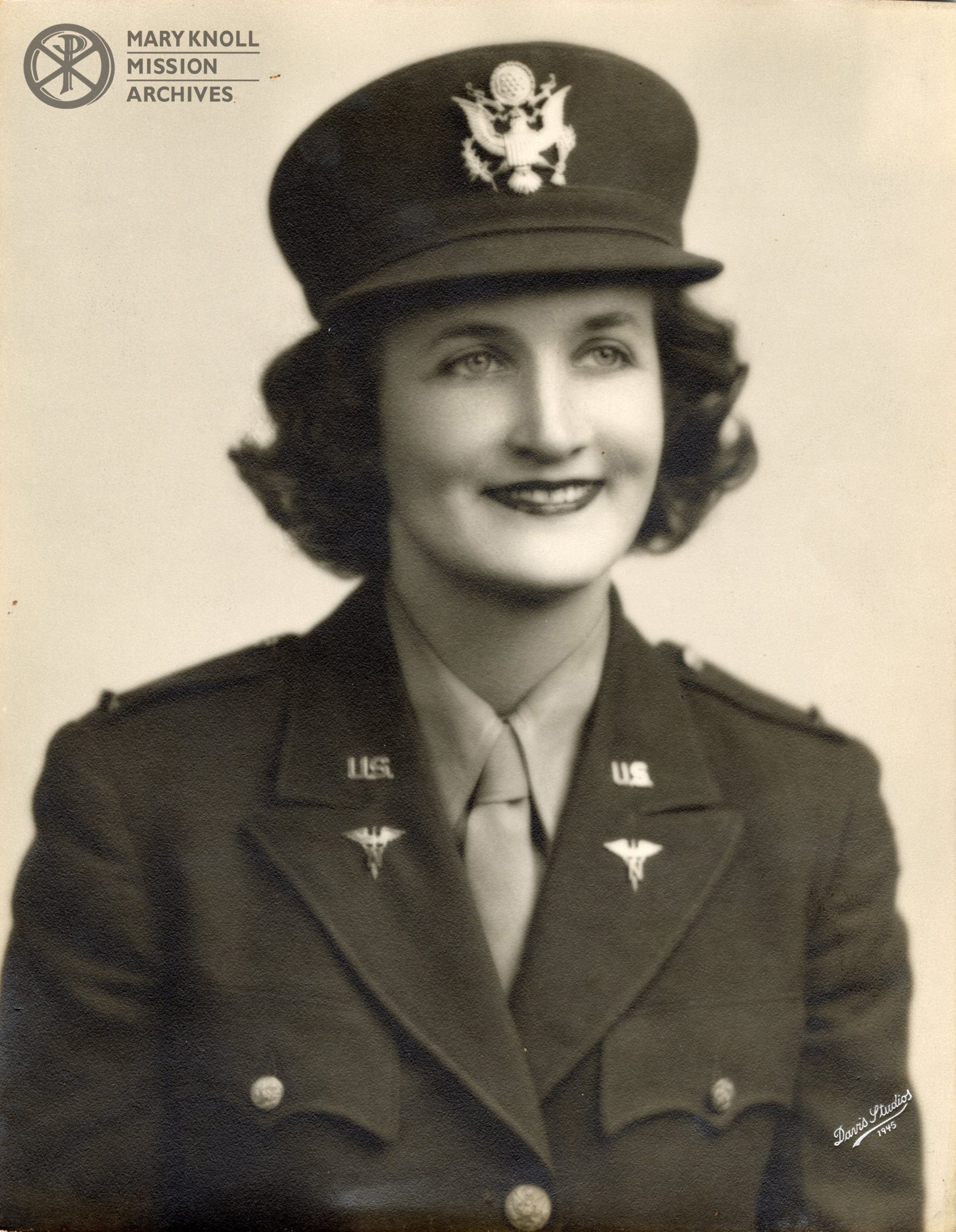
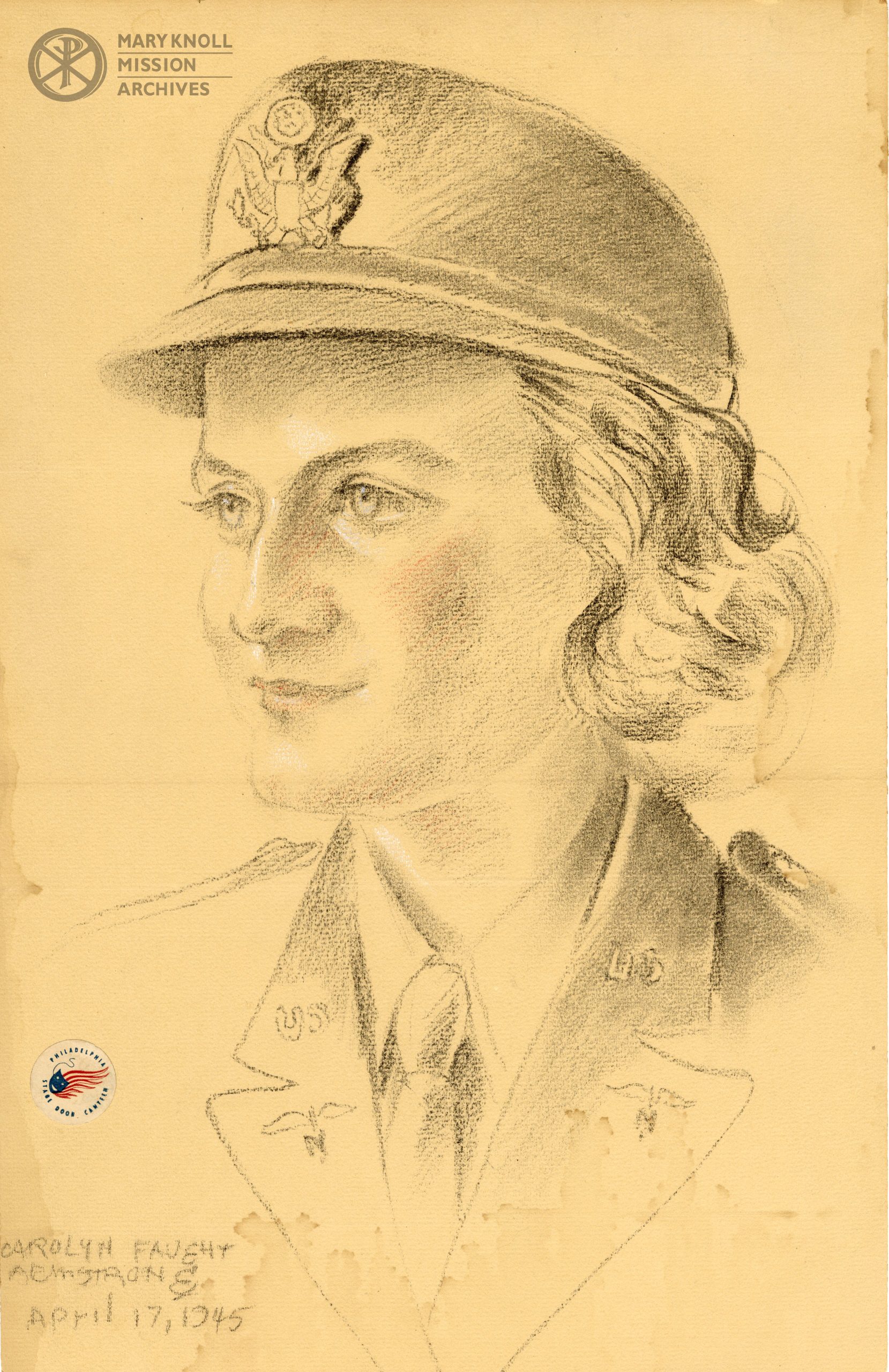
While not in combat roles, Women occupied key roles that kept the Military machine running during World War 2. One of the most common positions was amongst the Army Nurse Corps, which Sr. Mary Reese was a part of. She spent most of the war years attending school, joining in March 1945 and serving about a year in the Pacific theater. The Army Nurses served a vital care givers for the wounded and dying, offering compassion and comfort. They were the backbone of field hospitals, sometimes operating only a few hundred meters from the front lines.
Another Sister, Sr. Mary Stolz, served with the US Navy Women’s Reserve. Mary Stolz was already heavily involved in her community, being a part of the Legion of Mary and the US Air Force Civil Service. She felt the need to do “more” in the war, and thusly join the Navy’s WAVES branch (Women Accepted for Volunteer Emergency Service). This branch was established to help fill a wide variety of positions on the Homefront, from secretaries to doctors and engineers.
Our last Maryknoller to feature wasn’t necessarily a veteran of World War 2, but played a unique role in the war effort. Sr. Mary Louise Teufel was an university student when a professor recommended her to be an aeronautical engineer for Curtiss-Wright. Throughout the course of the war, Mary Louise worked as a flight research assistant for the Airplane division. It’s possible she worked on the C-76 Caravan, a wooden cargo plane prototype designed to save on aluminum. Mary’s time at Curtiss-Wright led to her joining the Army Special Services Division, responsible to entertaining the troops overseas. She served in this capacity from 1948-1952, when another life event turned her towards Maryknoll.
That is just a brief look at 10 of the 86 Maryknollers who served in some capacity during World War 2. During the war, many Americans felt compelled to serve in whatever way they could, whether it be on the front-lines, or at home. Let us take this Memorial Day to remember their service and sacrifice.
